Georgia Tech Video Game Design

Louie & Clara

A tragic Darwinian quest

Pilot Louie's surgical nanobot through a bloodstream under siege. Destroy viruses, protect healthy cells, and contain an infection that grows more dangerous the longer you wait.

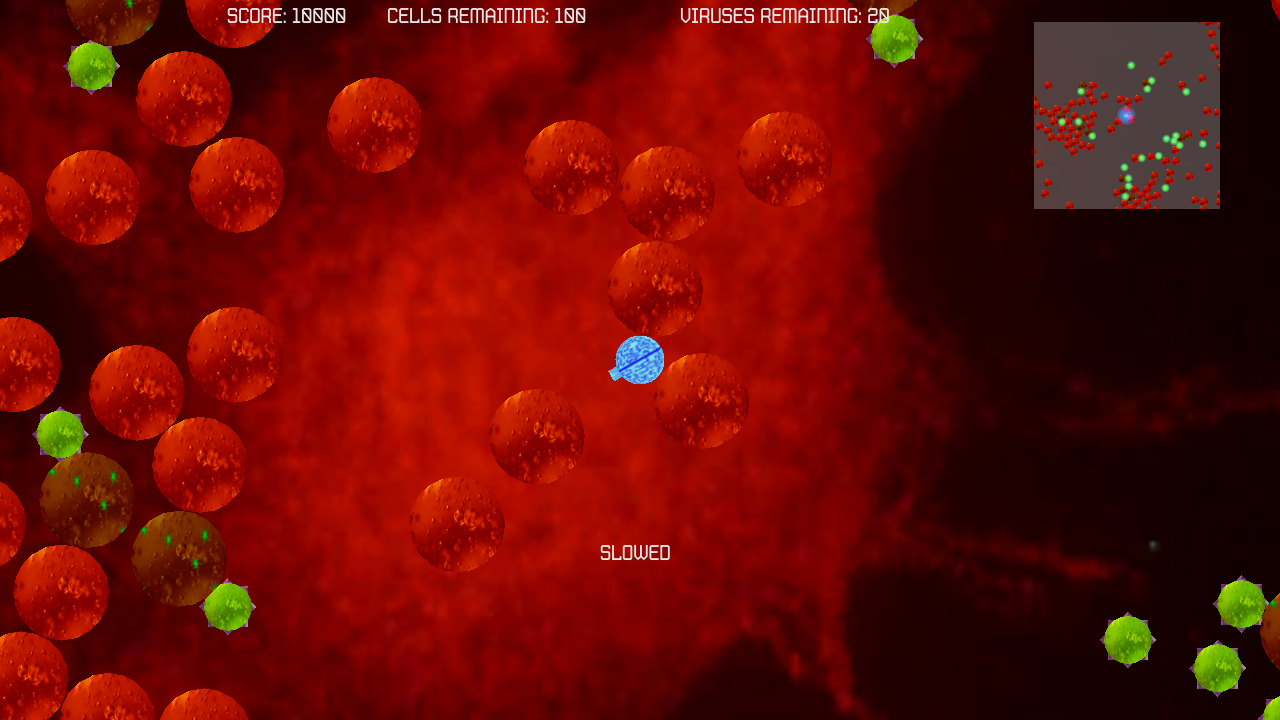
Louie's surgical nanobot navigating cells and viruses with the minimap visible

The project

Built for the classroom

Louie & Clara was created for the Georgia Tech Video Game Design class with Talia Knapp. I programmed the game, including player controls, combat, enemy and cell behavior, physics, spawning, camera, HUD state, audio triggers, and win/lose logic. Talia designed and produced the complete user interface, wrote the story, and gave the game its name.

The objective

Stop a living chain reaction

Viruses pursue cells and corrupt them into new threats. The player must balance direct attacks with crowd control, clearing viruses without destroying the cells they are trying to save. The result is a compact action loop built around urgency, positioning, and careful timing.

How it plays

A small arena with escalating pressure

UnityC#WebGL

Drive the nanobot

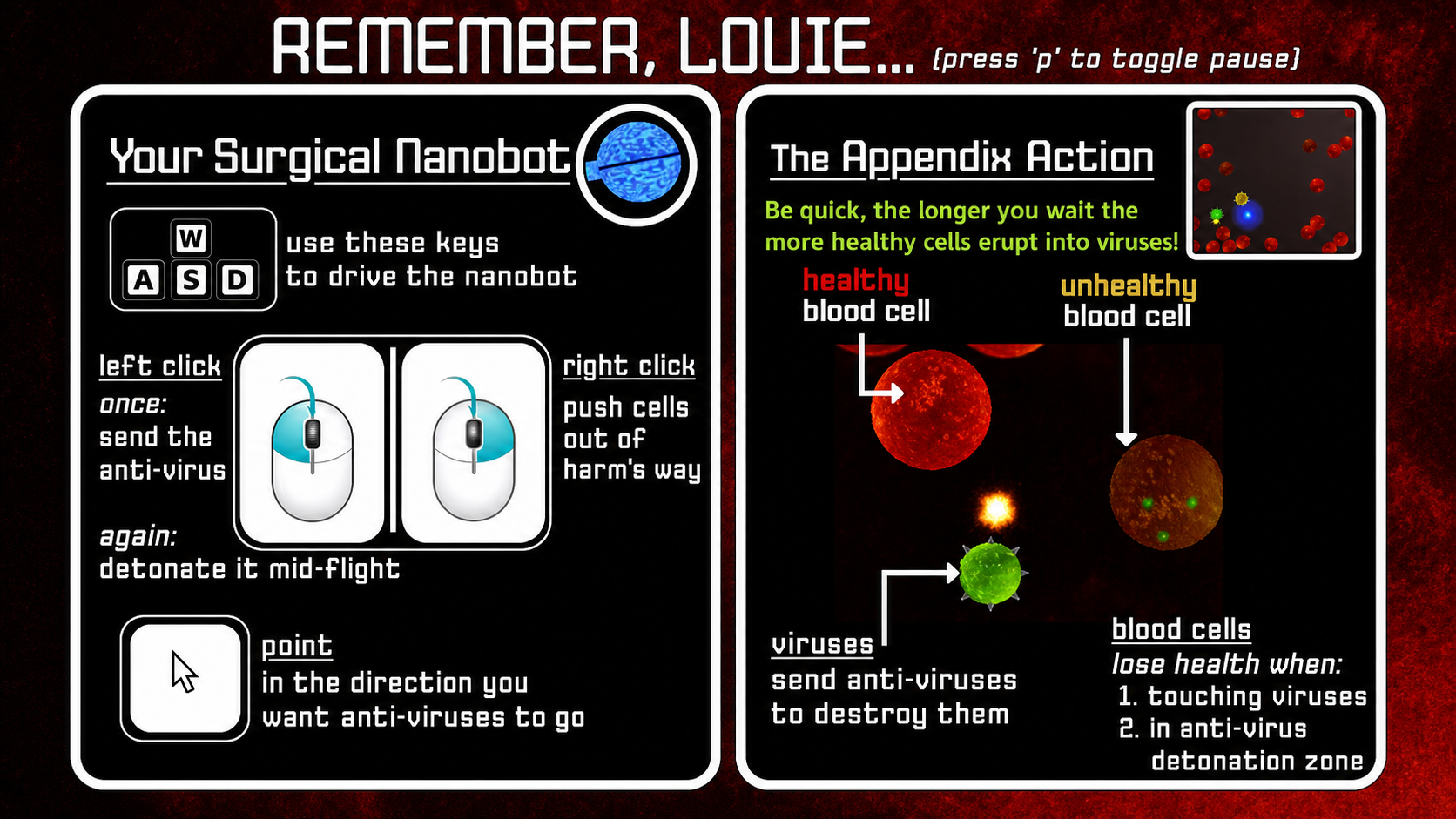
Use WASD to move through the bloodstream while aiming independently with the mouse.

Launch and detonate

Fire an anti-virus projectile, then trigger it again in flight for a timed area effect.

Protect the cells

Push cells out of danger and keep viruses from turning healthy tissue into new enemies.

Mechanics and programming

Systems behind the pressure

I programmed the arena as a set of interacting systems rather than scripted encounters. Viruses choose targets, pursue nearby cells, attach on contact, slow the nanobot, and turn destroyed or corrupted cells into new threats. Rigidbody movement, collision detection, overlap checks, penetration correction, boundary handling, and force-based push attacks keep the crowded arena responsive.

A secondary orthographic camera renders the full playfield as a minimap while the main camera follows the action. Particle systems communicate shots, detonations, infections, and destroyed targets; gameplay events trigger distinct firing, pushing, corruption, splat, victory, and loss sounds. The HUD coordinates pausing, spawning, timed corruption, live cell and virus counts, scoring, and the complete win/lose state flow.

Language and modernization

From UnityScript to C# and Unity 6

The original class project was programmed in UnityScript, Unity's former JavaScript-like scripting language. That version established the game loop, physics behaviors, enemy and cell logic, controls, HUD, audio, and effects, but it depended on an obsolete language and an older Unity runtime.

In 2026, I ported the project to C# and Unity 6 with help from Codex. The migration preserved the original scene, prefabs, artwork, serialized gameplay tuning, and design while replacing the UnityScript components with maintainable C# equivalents. The port was necessary to make the game playable online again: its original browser release depended on the Unity Web Player plug-in, which browsers stopped supporting. I also adapted legacy physics, input, rendering, particle, camera, and build behavior for a modern Unity 6 WebGL release that runs directly in supported browsers without the old plug-in.
Narrative setup

A mission inside Clara

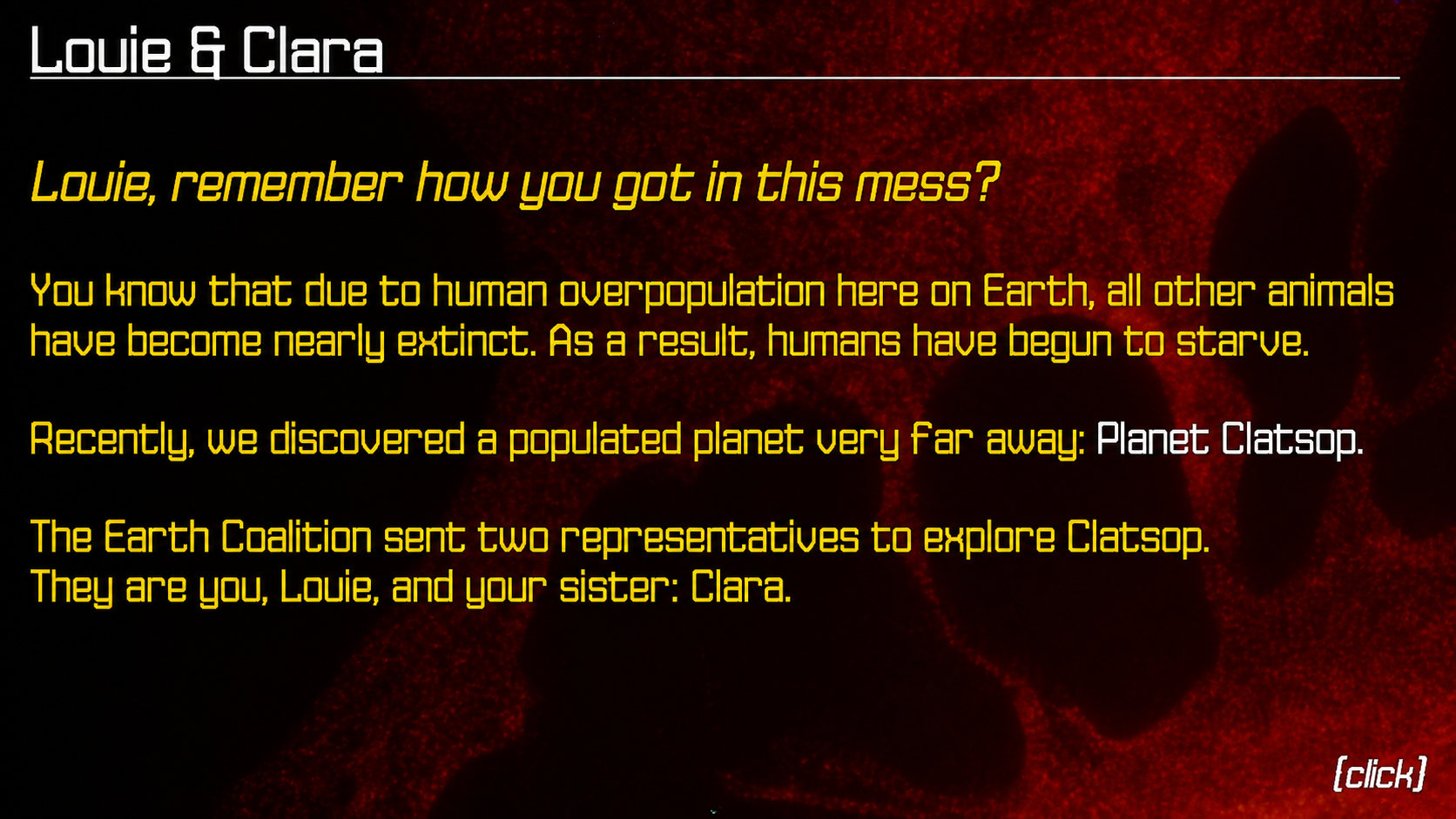
Louie and Clara's science-fiction story frames the microscopic battle and turns a systems-driven survival challenge into a personal rescue mission.

Louie and Clara story introduction

Interface design

Talia Knapp's UI and story

The instruction screen teaches movement, aiming, attacks, and the infection system in one cohesive visual. She also wrote Louie and Clara's story and named the game. That story carries into the final result, where the population saved depends on how quickly the mission is completed and how many cells survive. Winning quickly is not enough—the best outcome also requires protecting as many cells as possible.

Louie and Clara controls and gameplay instruction screen